
Ottawa was picked as Canada’s capital on December 31, 1857, after four better-known rivals fought for the job and lost. The choice came from Queen Victoria. The result still feels odd if you arrive expecting a compact government town.
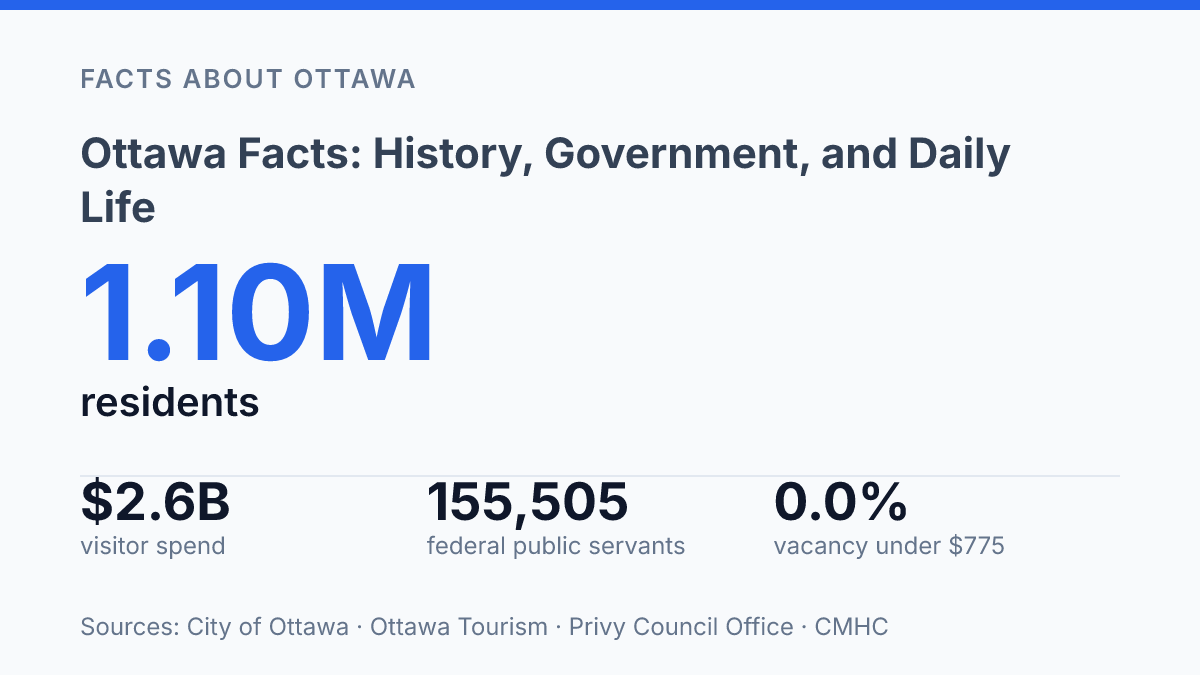
The municipality now counts 1,097,760 residents across 2,796 km². Its land area is larger than Calgary, Edmonton, Toronto, Vancouver, and Montreal combined. In my honest opinion, that scale is the first clue that the capital is stranger, bigger, and harder to pin down than its calm postcard image suggests.
The story turns on power, language, weather, and daily tradeoffs. You’ll see how a former lumber settlement became a federal seat, why public institutions steer the local economy, and how bilingual neighbourhood life sits beside high rents, winter realities, and summer events that pull hundreds of thousands of people into the city.
Why Ottawa became Canada’s capital
Canada’s capital was picked partly because it wasn’t the obvious winner. Queen Victoria’s December 31, 1857, choice of Ottawa as capital of the Province of Canada came after Kingston, Montreal, Toronto, and Quebec City had competed for the role, according to Canada Post / Government of Canada. The decision looked odd if you judged cities by polish, wealth, or prestige.
The logic predated Victoria. Lord Sydenham had already seen the strategic value of a seat between Toronto and Montreal. It sat inland, away from easy attack, and close enough to both English and French political centres to avoid looking like a prize handed to one side.
Size mattered less than survival. Bigger cities had money, newspapers, and political muscle. They also carried local rivalries and border exposure.
Ottawa won for security and geography. The choice also made it feel less obvious than flashier rival cities… and that’s exactly why it stuck.
A capital chosen as a compromise can sound temporary. This one wasn’t. In my view, the smartest part of the decision was its restraint: it picked a place that could serve the country before it tried to impress it.
The irony is that the compromise didn’t stay small. The Ottawa-Gatineau census metropolitan area now has 1.4 million people, enough to make the old image of a quiet government town feel badly outdated. Its capital status started as a defensive calculation, then became the frame for a much larger urban region.
Federal institutions that shape the city
Nearly half of Canada’s federal public service works in the National Capital Region, so government isn’t just a backdrop here. It sets the workweek.
As of March 2024, the region had 155,505 federal public servants, equal to 42.3% of the national total, according to the Privy Council Office. That makes the public service the city’s largest employer by a wide margin.
Parliament Hill gives that workforce its symbolic centre. The Centre Block is the best-known building in the parliamentary precinct. The Peace Tower still anchors the skyline even as restoration work changes how people move around the site.
The point isn’t only architecture. Laws, committee hearings, protests, press conferences, and national ceremonies all pull daily attention toward the same few blocks.
Power also sits outside Parliament. The Supreme Court of Canada gives the city a legal gravity that most capitals don’t display so plainly. Rideau Hall adds another layer, as the official residence and workplace of the governor general.
These places don’t operate like attractions first. They are working institutions. That matters.
The tradeoff is real. Federal employment gives the city unusual stability, especially when private-sector cycles hit harder elsewhere.
But it can also make the pace feel cautious beside Toronto’s finance-driven speed or Montreal’s cultural churn. In my honest opinion, that slower rhythm is not a flaw in the city’s identity. It is the price of being the place where national administration happens every day.
You feel it in small ways. Commutes peak around office schedules. Cafés fill with badge-wearing workers. Policy language leaks into ordinary conversation.
Yet the same system that can make the capital feel buttoned-up also keeps tens of thousands of households tied to steady salaries, pensions, contracts, and support work. Government doesn’t merely occupy the city. It organizes it.
Neighborhoods, language, and city life
The municipality covers more land than Calgary, Edmonton, Toronto, Vancouver, and Montreal combined. That scale shapes daily life more than outsiders expect, according to its 2024 annual report. The same report counts 6,043 km of roads, a number that explains why a short-looking trip on a map can feel like a cross-town project.
A 36% English-French bilingual rate sounds tidy until you stand in different parts of the city. The capital is officially bilingual, but daily life isn’t evenly bilingual everywhere. That gap says more about the city than any slogan does.
English and French show up in signage, school choices, public notices, and service counters. You’ll hear both languages in central areas and in workplaces tied to national institutions. But in some suburban routines, one language clearly dominates the grocery aisle, the playground, or the bus stop.
ByWard Market carries the loudest identity, yet residents don’t treat it as a postcard. They use it for produce runs, restaurants, late nights, and quick meetups.
The catch is that the same energy brings noise, crowds. A sharper edge after dark.
Centretown feels more lived-in. Apartment towers, older walk-ups, offices, cafés, and bike lanes sit close together, so daily errands can happen without a car.
It’s convenient. That convenience comes with tight housing, street-level friction, and less privacy than people expect from a government town.
Kanata flips the pattern. It reads as suburban and tech-driven, with office parks, family housing, hockey schedules, and car trips built into the week. The tradeoff is plain: more space, longer commutes.
The Ottawa River and Rideau Canal make the city legible before they make it convenient. The river separates the Ontario side from Gatineau, then connects both sides through bridges, shared work patterns, and weekend movement. The canal cuts through central neighborhoods and gives people a route for walking, cycling, skating, and simply orienting themselves.
In my humble opinion, the real character of the city sits in those contrasts: bilingual but uneven, spacious but slow to cross, calm on weekdays but sharply different from one district to the next.
Climate, festivals, and what surprises first-time visitors
The capital’s biggest personality trait may be its willingness to turn punishing cold into a public event. Winter lows regularly drop below -20°C.
That changes how people move, dress, plan, and socialize. Visitors who expect only stone buildings and formal ceremonies quickly learn that the forecast has real authority here.
When conditions allow, the Rideau Canal Skateway becomes the clearest symbol of that habit. It’s not just a photo stop. It turns a frozen waterway into a commuter route, a meeting place.
A reason to go outside when most cities would retreat indoors. But it also depends on weather that has become less predictable, so its opening is never something the city can take for granted.
The same contrast defines the event calendar. Canada Day on Parliament Hill brings the national ceremony people expect on July 1, with flags, security lines, concerts, and crowds gathered around the country’s most recognizable civic stage. Winterlude does the opposite seasonally: it makes ice, snow, and cold the point rather than the problem.
Spring and summer then arrive with a kind of pent-up force. The long cold season compresses social energy into warmer months, so patios, parks, concerts, food events, and open-air gatherings fill the calendar fast.
According to Ottawa Tourism’s 2024 Economic Impact Study, the city welcomes 9.8 million visitors a year. That number makes more sense once you see how much of the warm season is organized around being outside.
That’s the surprise. From a distance, the city can look ceremonial and restrained, but daily life is far more weather-driven than its official image suggests. In my view, the most revealing version of the capital isn’t the one behind a podium. It’s the one skating, lining up for a winter event, or trying to fit three summer plans into one clear weekend.
What the capital asks you to notice next
Treat 2026 as more than a birthday marker. The 200th anniversary of Bytown gives the capital a rare chance to explain itself without hiding behind Parliament Hill.
That matters. A city that welcomes 9.8 million visitors a year can still feel private, administrative, and oddly understated. In my humble opinion, the best way to understand it isn’t to chase one grand symbol, but to notice the friction between ceremony and rent, bilingual pride and daily convenience, national memory and ordinary commutes.
Plan your next look around that tension. The capital’s real story starts where the official tour usually ends.
Frequently Asked Questions
Q: Why is Ottawa the capital of Canada?
A: Ottawa became the federal capital in 1857 after Queen Victoria made the choice. Queen Victoria picked it partly because it sat between major English- and French-speaking regions, but also because its location was easier to defend than bigger cities. That’s the twist: it wasn’t the biggest city that won.
Q: Is Ottawa a good city to live in?
A: Yes, if you want a city that feels orderly without being dull. Ottawa has strong public services, lots of parks. A steady job market tied to government, tech, and education. In my view, it’s a smart place to live if you want stability more than chaos.
Q: What is Ottawa known for besides Parliament Hill?
A: Ottawa is known for its museums, festivals, and outdoor spaces… not just politics. The city has a strong winter identity too, with skating, snow trails, and cold-weather events that shape daily life. That’s the part visitors miss when they treat it like a nine-to-five government town.
Q: How cold does Ottawa get in winter?
A: Very cold. Winter temperatures regularly drop below freezing, and wind makes it feel even harsher… so residents dress for it instead of pretending it’ll pass quickly. The payoff is real winter recreation. You need to respect the season first.
Q: What kind of jobs are common in Ottawa?
A: Government jobs are a big part of the local economy, but they’re not the whole story. Ottawa also has work in tech, healthcare, education, and tourism. The city isn’t as one-note as people think. That mix matters because it gives the city more stability than a single-industry town.