
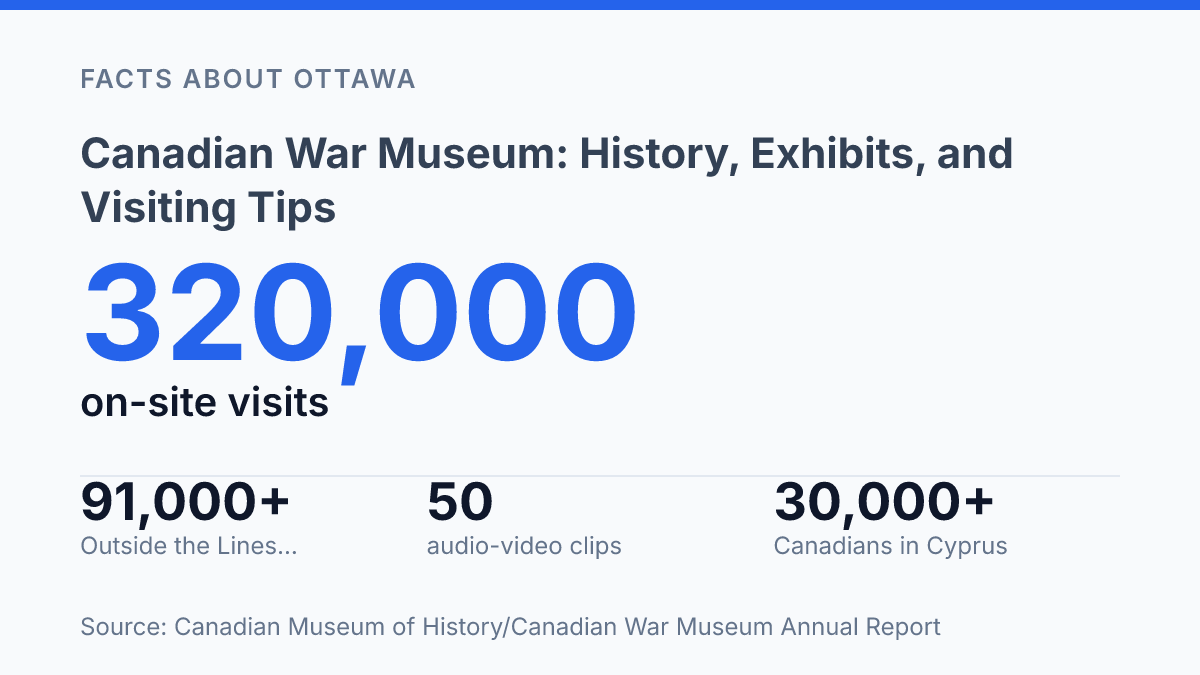
The Canadian War Museum recorded 320,000 on-site visits in 2024–2025, a figure that shows both its national reach and the challenge of interpreting conflict for audiences well beyond military specialists. Its recent exhibitions suggest why the institution remains a major Ottawa stop: Outside the Lines – Women Artists and War drew more than 91,000 visitors with works by 52 women artists, while In Their Own Voices uses testimony from veterans and loved ones to connect service history with living memory. The museum’s force comes from this range.
Armoured vehicles, art, oral history, peacekeeping records, and Memorial Hall all serve different kinds of evidence. A visit is therefore less about moving through a fixed military chronology than about seeing how Canada has recorded, debated, and commemorated war. The sections ahead explain what the museum covers, which objects deserve priority, how to plan time at LeBreton Flats, and why its role differs from other national museums in Ottawa.
What the museum covers and why it matters
The Canadian War Museum recorded 320,000 on-site visits in 2024–2025, a scale that shows how central it remains to public interpretation of war, service, and remembrance in Ottawa, according to the Canadian Museum of History/Canadian War Museum Annual Report 2024–2025. Its role is not simply to display military objects, but to preserve and present Canada’s military past as a national institution, connecting official history with the experiences of individuals who served, worked, waited, mourned, or remembered.
Officially opened in 2005, the museum occupies a prominent site on LeBreton Flats, west of Parliament Hill and close to the Ottawa River. The building is strongly associated with the architect team of Raymond Moriyama and his firm, whose design gives the institution a physical presence suited to both public commemoration and historical study. Its location matters because LeBreton Flats places the museum within the capital’s civic and ceremonial geography without making it part of Parliament itself; the result is a setting that supports reflection as well as national storytelling.
The collection’s scope is broad enough to move beyond a single combat-focused narrative. Artillery, uniforms, military vehicles, medals, official records, photographs, letters, art, and personal wartime artefacts all help show how conflict affected institutions, technology, families, and memory. These materials allow the museum to interpret major themes such as service, sacrifice, command, industrial production, home-front life, peacekeeping, and remembrance without reducing military history to battles alone.
A national museum, however, cannot make every gallery visit exhaustive. Its strength lies in selection: objects and exhibitions are arranged to create a coherent account of Canada’s military experience while leaving room for deeper research, changing displays, and specialized programs. That balance explains why the museum functions as a major Ottawa reference point: it gives visitors a structured entry into a large and difficult subject, while preserving the evidence needed for more detailed historical interpretation.
Key galleries and signature objects to see
A Sherman tank can dominate attention in seconds, but a Vickers machine gun often explains the museum’s argument more sharply: modern war is shown not only through scale, but through systems of technology, labour, fear, and endurance. The strongest displays pair large objects with interpretation that slows the experience down, connecting machinery to tactics, industrial production, and the people affected by its use. That balance keeps the galleries from becoming a simple inventory of military equipment.
The LeBreton Gallery is the clearest example of this approach. Located on the lower level, it has a suggested visit time of 45 minutes according to the museum’s current visitor information, which signals both its size and its density.
Its large military hardware displays include armoured vehicles, guns, and transport equipment arranged so that visitors can compare design, function, and historical period rather than seeing each object in isolation. The Beatty family vehicle collection is one of the named features associated with this emphasis on machinery, showing how preserved vehicles can carry technical, operational, and commemorative meanings at the same time.
Across the permanent galleries, the chronological structure gives the objects their interpretive frame. The First World War sections use weapons such as machine guns to show how industrial firepower changed battlefield conditions, while the Second World War galleries expand the story through mobilization, global operations, and equipment such as tanks.
Later sections move into Korea, Cold War tensions, and peacekeeping, where the material culture becomes less about mass mobilization alone and more about alliance commitments, limited wars, and international missions. This progression helps explain why a single artefact rarely stands for a whole conflict; its meaning depends on where it appears in the wider sequence.
Some of the most memorable material is quieter than the hardware. Memorial Hall, for example, is designed so that at exactly 11 a.m. on November 11, sunlight falls on the headstone of Canada’s Unknown Soldier, according to the museum’s published description.
That object works differently from a tank or gun: it does not illustrate firepower, but concentrates loss, anonymity, and remembrance into a single spatial moment. The contrast is central to the visitor experience, since spectacle introduces the scale of war while interpretive context explains its human and national consequences.
Planning a visit to LeBreton Flats
Few major Ottawa museums are easier to pair with a downtown day: the current address, 1 Vimy Place, Ottawa, Ontario K1A 0M8, is a short walk or transit ride west of Parliament Hill and the central business district. The location makes it practical to combine the visit with the National Holocaust Monument, nearby riverfront paths, or a cross-river trip to the Canadian Museum of History in Gatineau, without treating the museum as an isolated stop.
Typical public hours are daytime-oriented, commonly running from morning to late afternoon, with seasonal adjustments and occasional extended periods around holidays or programming. Admission is ticketed, with the museum listing reduced categories such as seniors, students, youth, and family tickets; online purchase may also be cheaper than buying at the desk. Free access is normally offered during selected periods, including Thursday evenings and major commemorative days such as Remembrance Day, though dates and hours should be checked against the museum’s current schedule before setting plans.
Access is straightforward by several modes, but each has a different practical advantage. OC Transpo service and the O-Train put Pimisi Station within walking distance, which is often the simplest option from downtown or from other central Ottawa stops. Drivers can use paid on-site parking, while cyclists and pedestrians can approach via the Ottawa River pathway network, a useful link for visitors already moving between the riverfront, LeBreton Flats, and Gatineau.
Timing matters more than the central location might suggest. In 2024–2025, the museum recorded 320,000 on-site visits out of 999,000 combined visits to the two national museums, below its 390,000 target, according to the Canadian Museum of History/Canadian War Museum Annual Report 2024–2025.
That scale indicates a site that is busy but usually manageable, although school breaks, free-admission periods, public ceremonies, and special events can change crowd patterns sharply. For most itineraries, a weekday daytime visit offers the most predictable experience, while evenings and commemorative dates are better suited to visitors who value atmosphere over quiet galleries.
What sets it apart from other Ottawa museums
Few Ottawa institutions turn an annual date into an interpretive mechanism as directly as the war museum does on November 11. According to the Canadian Museum of History/Canadian War Museum Annual Report 2023–2024, Remembrance Day drew 4,780 visitors to the war museum, an increase of 1,561 over the previous year; across the two affiliated museums, 7,410 people visited that day using free admission. Those figures show that commemoration is not an occasional theme for the institution, but one of the ways its public role becomes most visible.
Compared with the National Gallery of Canada, the distinction is especially clear. The gallery uses visual art as its primary lens, while the war museum treats art, testimony, objects, and military material as evidence for interpreting conflict and service.
A recent example is Outside the Lines – Women Artists and War, which ran from May 2024 to January 2025 and drew more than 91,000 visitors, according to the 2024–2025 annual report. Its significance lies in how it expanded war interpretation beyond weapons and command decisions, using artistic records to examine witness, labour, trauma, and memory.
The contrast with the Canadian Museum of History is different but equally useful. That institution presents a broad account of Canadian social and cultural development, while the war museum narrows the frame to organized violence, military institutions, veterans’ experiences, and public remembrance. The narrower scope can make the institution feel more concentrated than a general history museum, but that focus gives it a clearer interpretive identity: national history is approached through moments when conflict reshaped citizenship, technology, diplomacy, families, and public memory.
The Diefenbunker offers another point of comparison because it is rooted in one Cold War site and a specific emergency-government function. The war museum has a broader chronological and thematic mandate, including peacekeeping and living memory.
Its 2024 online exhibition In Their Own Voices used 50 video and audio clips from more than 200 interviews with Canadian veterans and loved ones, while Cyprus – A Divided Island marked the 60th anniversary of the UN mission in Cyprus and highlighted more than 30,000 Canadians who served there from 1964 to 1993. In that context, commemorative touchstones such as Vimy Ridge anniversaries and Remembrance Day are not isolated ceremonies; they are part of a wider institutional method for connecting military history to public responsibility.
Where military history becomes public memory
The museum’s next challenge is not only preserving objects, but preserving context as first-hand witnesses become fewer. Projects such as In Their Own Voices show one path forward, using recorded testimony to keep personal experience attached to official history. That matters because a tank, a uniform, or a peacekeeping medal can be read as technology, service record, national symbol, or family memory depending on the evidence placed around it.
A practical visit gains depth when it leaves room for that complexity rather than treating the galleries as a checklist. At LeBreton Flats, the strongest impression often comes from the contrast between scale and silence: large machines of war displayed near a Memorial Hall where sunlight marks one grave at 11 a.m. on November 11.
Frequently Asked Questions
Q: What can visitors see at the Canadian War Museum?
A: The museum presents Canada’s military history through artefacts, vehicles, uniforms, personal accounts, and large-scale exhibitions. Its collections cover conflict from early colonial wars to modern peacekeeping and international operations, which helps place military events in a broader social and historical context.
Q: How long does it take to visit the Canadian War Museum?
A: A full visit usually takes several hours, especially for visitors who spend time in the main galleries and temporary exhibits. Shorter visits are possible, but the size of the collection means a quick stop will only cover part of the material on display.
Q: Is the Canadian War Museum suitable for children?
A: The museum can be appropriate for families, although some exhibits address war in a serious and graphic way. Parental guidance is useful because the experience can be educational for older children while still being emotionally demanding for younger ones.
Q: Are there guided tours or audio guides available?
A: Many major museums offer guided interpretation or self-guided resources, and this museum is no exception in its approach to visitor support. These tools help explain historical context, which is especially useful for visitors who want more detail than exhibit labels can provide.
Q: What is the best time to visit the Canadian War Museum?
A: Weekdays and earlier arrival times are generally the best choice for a quieter visit. School holidays and weekends tend to be busier, so timing can affect how easily visitors move through galleries and interact with exhibits.