
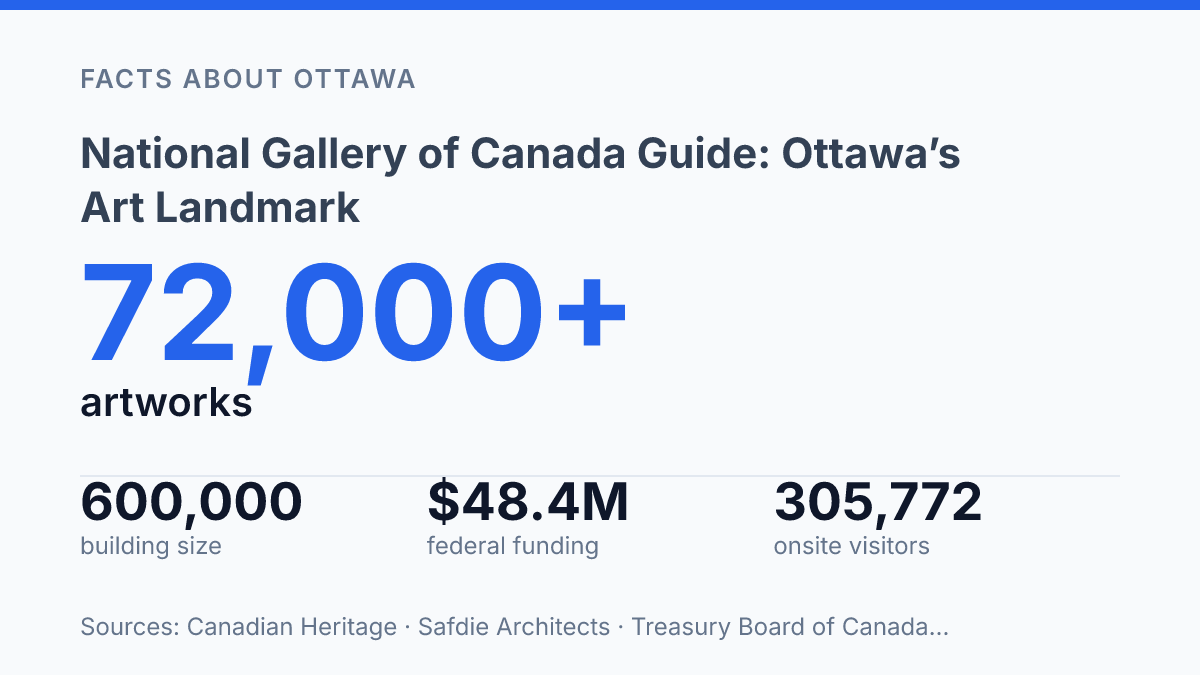
The National Gallery of Canada holds more than 72,000 works, but fewer than 306,000 people walked through its Ottawa doors in 2024–25. That gap is the point.
Founded in 1880, the Gallery sits in a capital where four of Canada’s six national museums are concentrated. This isn’t accidental civic pride. It’s a federal choice about where national memory gets housed, funded, and displayed.
You’ll feel that choice in the 600,000-square-foot building, in the scale of the galleries, and in what actually appears on the walls. The place is part art museum, part state architecture, and part live collecting machine with millions still assigned to new works each year.
In my honest opinion, that’s why a visit feels less like checking off a famous attraction and more like stepping into a national argument about what Canada chooses to preserve.
Why Ottawa Built Canada’s national art museum here
Ottawa didn’t get Canada’s national art museum by accident. The capital concentrates cultural memory the way Parliament concentrates political power.
That is why the National Gallery of Canada sits in Ottawa, Ontario, Canada’s capital city, rather than in the country’s biggest art market. It serves as the country’s national art museum, so its job reaches beyond tourism or civic pride.
The current home opened in 1988. The institution is older than the building. Its national role is to shape Canada’s public art identity through collecting, preserving, displaying, and debating what belongs in the shared record.
According to Canadian Heritage / Government of Canada, 4 of Canada’s 6 national museums are in the National Capital Region, including the Gallery, which was founded in 1880. That clustering isn’t random. It places art beside federal memory, national history, and public accountability.
A local gallery answers first to its community. A private collection reflects an owner’s taste.
This museum answers to the public idea of Canada. That makes the visitor experience different before you even enter a room.
The title can sound stiff, almost ceremonial. But the real draw is practical: this is a public museum in the capital, not a locked-away prestige project.
You don’t visit only to admire famous works. You visit to see how a country chooses to represent itself.
That choice is never neutral. Collections elevate some stories and leave others in shadow. In my view, the museum matters most when it lets those tensions stay visible, because national art should feel argued over, not settled.
How big the building is, and why that matters
Only about a quarter of the building is gallery space. That ratio explains the visit better than the exterior ever could. The museum covers 46,621 square metres, with 12,400 square metres used for exhibiting art.
That leaves a huge share for circulation, gathering, storage, education, services. The kind of breathing room big public museums need but smaller galleries can’t afford.
The public payoff is scale you can feel. Large exhibitions don’t have to squeeze into a few rooms.
Permanent collection areas can sit nearby without being pushed aside every time a major show arrives. You get wider transitions between zones, longer sightlines, and enough space for a visit to slow down instead of feeling like a hallway shuffle.
That amount of exhibition space puts the Gallery among the largest art museums in North America by display area. Size alone doesn’t make a museum better. It does change what curators can do.
They can hang works with distance around them. They can build exhibitions with pauses, not just walls full of objects.
Scale also changes how you move through the place. A compact museum tells you what to see next.
This one gives you options. You might spend an hour with one exhibition and barely touch the permanent collection, or you might skip the temporary show and follow a historical route instead.
The tradeoff is real: bigger doesn’t mean you see everything. It often means you see less, more deliberately. In my honest opinion, that’s the smarter way to experience a museum of this size.
Treat it like a set of choices, not a checklist. If you try to cover every room with equal attention, the building wins and your attention loses.
What visitors actually see inside
Only 12,400 square metres of the building is where the art does the talking, and that’s the number that matters once you’re inside. The rest of the place supports the visit: circulation, learning spaces, gathering areas, conservation work, storage. The public rooms that make the museum feel ceremonial rather than crowded with objects.
That distinction changes how you read the experience. You’re not walking through a warehouse of everything Canada owns. You’re moving through edited rooms, where the curators decide what deserves space, sequence, and attention.
The expected range is broad: Canadian art, Indigenous art, and international works all have to sit in conversation here. That mix is the point of a national collection.
It can’t just celebrate one tradition. It also can’t flatten every tradition into the same story.
The scale behind the walls is much larger than any single visit can show. Canadian Heritage reports that the collection holds more than 72,000 works.
The Gallery’s annual reporting says it added 334 works in 2024–25 through purchases and donations. So the rooms you see are a selection, not a full inventory.
A short visit works best when you accept that limit. Pick a major exhibition or a few permanent galleries and give them time. Trying to “do” the whole museum in one pass turns the visit into a march, and that’s the least rewarding way to see art.
Longer visits work differently. Permanent galleries give you the backbone: national narratives, key movements, changing interpretations.
The quieter works that don’t always get promotional attention. Major exhibitions create the event, as Riopelle: Crossroads in Time did when it drew 87,974 visitors, according to the Gallery’s 2023–24 annual report.
A national museum should feel comprehensive. The best visits are usually selective. That’s the tradeoff between breadth and depth. In my humble opinion, the smartest way to experience the Gallery is to leave something unseen, because that means you actually looked at what you chose.
Why it stands out among North American museums
That is why its rank among North America’s largest art museums by exhibition space matters less as bragging rights than as visitor math. The real comparison is not who owns the most art. It is who can put enough work on view to make a national story feel legible.
Collection totals can mislead. The Metropolitan Museum of Art, the Art Institute of Chicago.
The Art Gallery of Ontario all carry different mandates, buildings, and civic pressures. A fair comparison asks how much a visitor can actually encounter, how clearly it is sequenced, and whether the galleries can support both major exhibitions and permanent displays without one crowding out the other.
Ottawa benefits because this scale sits in the downtown core, not on a remote cultural campus. The 2025–26 federal Main Estimates list $48,424,493 in voted budgetary funding for the Gallery, including acquisition support, according to the Treasury Board of Canada Secretariat. That kind of public investment gives the city a cultural anchor beside the institutions of government.
But size alone doesn’t make a museum memorable. Large rooms can flatten art if the route feels endless or the themes blur together. The harder task is turning display capacity into a focused visit, where you sense range without feeling processed.
The architecture raises that challenge. Moshe Safdie gave the building a ceremonial presence near Parliament. The museum never feels like a neutral container. It sits close enough to political power that art and public life press against each other.
2025–26 is a useful marker here because the Gallery is not just a monument from an earlier cultural moment. It still receives public money to collect, show, and interpret art at national scale. In my view, Ottawa’s advantage is that the museum turns the capital into a place where national identity can be questioned, not just displayed.
What the Gallery asks of Ottawa visitors now
Treat the Gallery as a finished monument and you’ll miss the most useful truth about it: public money keeps changing what the nation can see there.
The 2025–26 federal estimates still set aside $8,000,000 for acquisitions, even as on-site attendance sits far below blockbuster tourist numbers. That tension matters.
The future of this museum won’t be decided only in Ottawa. Its Canada Pavilion drew large crowds at the Venice Biennale, and its website now reaches people who may never stand under the Great Hall.
In my humble opinion, the smarter visit is not to ask whether you’ve seen the collection. Ask what changed since the last time you looked.
Frequently Asked Questions
Q: How long does it take to visit the National Gallery of Canada?
A: Most visitors spend 2 to 3 hours there. You can stay longer if you want to see the major rooms at a slower pace. The building is huge at 46,621 square metres. A quick pass and a careful visit feel very different. In my view, a rushed trip misses the point.
Q: What makes the National Gallery of Canada worth visiting?
A: It’s Canada’s national art museum. The collection has real weight. The gallery also has 12,400 square metres of exhibition space, which gives it room to show a lot without feeling crammed. That scale matters. The quiet, focused viewing experience matters more.
Q: Where is the National Gallery of Canada located?
A: It’s in Ottawa, Ontario, right in Canada’s capital. That location makes it an easy stop if you’re planning a downtown visit or pairing it with other national landmarks. The setting fits the museum’s role… it’s not just a gallery, it’s a civic symbol.
Q: Is the National Gallery of Canada one of the biggest art museums in North America?
A: Yes. By exhibition space, it ranks among the largest art museums in North America. The key number is 12,400 square metres for exhibitions. That size gives the museum real room to breathe.
Q: Can you see the whole museum in one visit?
A: You can see a lot, but not everything in one rushed trip. The building covers 46,621 square metres, so trying to cover it all in a single afternoon is a mistake. Better to plan for your priorities and save the rest for next time.