
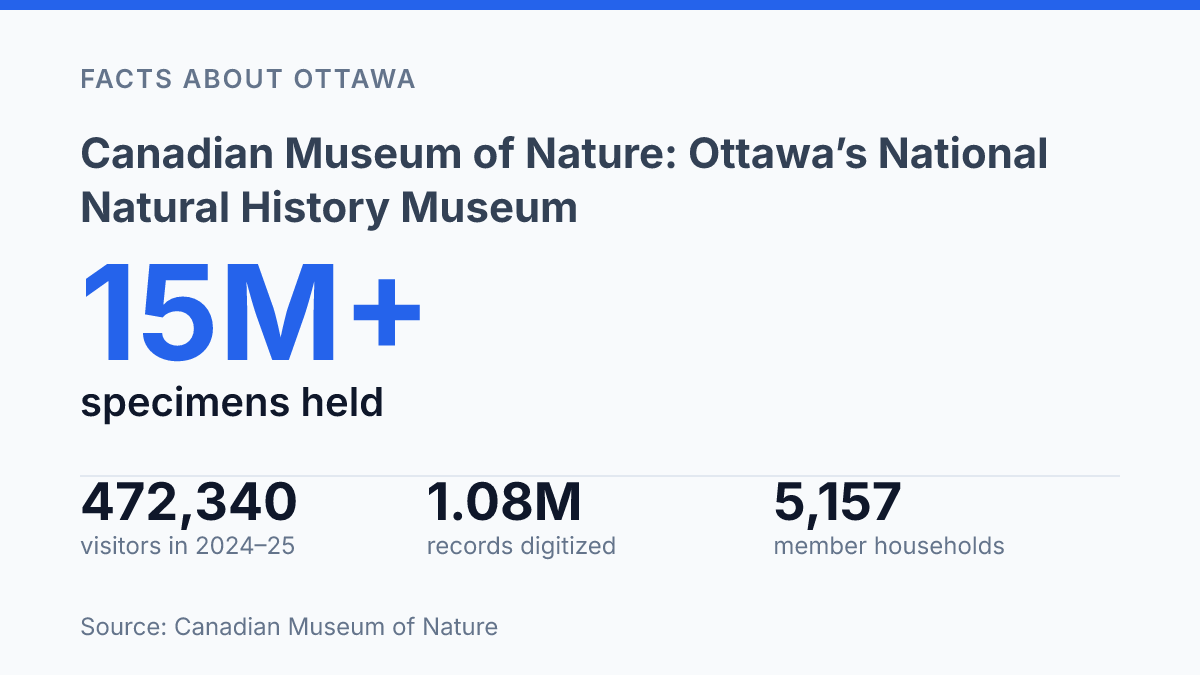
The Canadian Museum of Nature drew 472,340 visitors in 2024–25, more than its own target ceiling. The real surprise sits behind the galleries: a national collection topping 15 million specimens.
That scale changes how you should read the place. This isn’t just an Ottawa stop with dinosaurs and butterflies.
It’s a working national museum inside a building that once lost 24 metres of tower because the ground beneath it was sinking. Then, after the 1916 Parliament fire, it became the federal government’s emergency headquarters for four years.
The tension is the point. Heritage architecture, public science, school programs, ticket strategy, and crowd flow all meet in one stone building. In my honest opinion, that’s what makes this museum more useful than a quick rainy-day plan.
Why this Ottawa museum matters nationally
A museum with more than 15 million specimens or lots is doing something far bigger than filling a rainy afternoon in Ottawa. The Canadian Museum of Nature is Canada’s national natural history museum.
That status changes the scale of its work. It isn’t a local attraction that happens to have dinosaurs, minerals, birds, or Arctic material on display.
Its base in Ottawa, Ontario, within Canada’s National Capital Region, gives it a public role that few science museums can claim. The institution sits close to federal agencies, national archives, universities, embassies, and policy circles. That location matters.
Natural history here connects to questions about biodiversity, climate, conservation, northern research. The scientific record of a country that spans oceans, forests, grasslands, tundra, and coastlines.
The public galleries are only the visible part. Behind them is a research and collections operation that supports national science and heritage, according to the museum’s Annual Report 2024–2025.
In that year, the institution added 23,408 new specimens or lots to its holdings and mobilized 1,034,800 records or lots online. Those numbers point to a museum that preserves evidence, not just objects.
There’s a tension here, though. National status raises expectations, but many visitors still experience the place as a single-day Ottawa stop. They come between Parliament Hill, the Rideau Canal.
A restaurant reservation. That’s understandable. It’s also incomplete.
In my view, the real value of this museum is that it turns Canada’s natural record into something the public can question, not just admire. A fossil, bird skin, mineral sample, insect record, or Arctic plant specimen can support research long after a family has left the gallery. Tourism brings people through the doors, but science gives the institution its weight.
Attendance shows that the public-facing side still matters. The museum welcomed 472,340 visitors in 2024–25, according to its annual report, passing its target range of 400,000 to 470,000.
That demand proves the Ottawa site has broad appeal. But the deeper reason it matters nationally is simpler: it helps Canada collect, study, and share the evidence of its natural world.
Inside the Victoria Memorial Museum Building
An 18,910-square-metre stone landmark has to work like a high-capacity public machine. That’s the quiet surprise inside the Victoria Memorial Museum Building: it looks ceremonial. It runs on ticket lines, school groups, strollers, elevators, special events, and galleries that need to change without breaking the visitor flow.
The museum’s exhibitions and public programs are housed here, not in a neutral box built only for efficiency. The building sits in Ottawa, Ontario, and serves as the institution’s main public site. That matters when you walk through it.
The scale gives large displays room to breathe. It also creates a clear sense that you’re inside a civic landmark rather than a simple exhibition hall.
Demand puts real pressure on that setting. In 2024–25, the museum welcomed 472,340 visitors to the Victoria Memorial Museum Building, exceeding its target range of 400,000–470,000, according to the Canadian Museum of Nature, Annual Report 2024–2025. That number isn’t just a bragging point.
It tells you the building has to absorb crowds at a level that can strain entrances, circulation areas, washrooms, program rooms. The quieter spaces people expect from a museum visit.
That’s the tradeoff. The building’s historic character gives the visit weight, but modern museum life is restless. Family programming needs flexible rooms.
Temporary exhibitions need adaptable galleries. Public events need spaces that can shift mood fast. In my honest opinion, the building works best when you notice both sides at once: the formal architecture that slows you down. The practical machinery that keeps thousands of visitors moving through it without making the place feel like a mall.
What visitors can expect from exhibitions and programs
A short visit can feel harder here than a long one, since the galleries pull you in three directions at once: life, stone, and animal behavior. The permanent experience is built around natural history themes tied to Canada’s biodiversity, geology, and wildlife, so you’re not just looking at specimens in cases. You’re moving between big systems: how animals adapt, how rocks record deep time, and how northern ecosystems change under pressure.
That breadth is the museum’s strength. It creates a real tradeoff. If you only have an hour, you’ll need to choose between depth and variety. In my humble opinion, the best visit here is selective, not completist, because the strongest moments land better when you don’t rush every room.
Families tend to treat the museum as a hands-on learning trip. They move faster, stop at interactive stations, and care about pacing as much as content. Recent exhibition data supports that pattern: Bug Adventure attracted 103,742 visitors and generated 33,666 hands-on interactions, according to the museum’s 2024–2025 Annual Report.
School groups use the place differently. For them, the exhibitions sit alongside structured learning.
The program side matters just as much as the galleries. By March 31, 2025, free virtual school workshops had helped registrations rise from 109 to 419, and onsite plus virtual workshops reached over 17,000 students in 2024–25, according to the same report.
Casual tourists usually want the highlights, photos. A clear sense that they’ve seen something distinctly Canadian.
Adult visitors shouldn’t assume the museum is built only for children. Programs such as Nature Nocturne, which drew 8,425 attendees across its eleventh season, show how strongly the museum also serves adults who want science, social events, and after-hours access in the same visit.
Public programming isn’t a side dish here. It shapes how people encounter the exhibitions, whether through school sessions, family activities, special events, or seasonal shows. The smartest approach is to check what’s running before you arrive, then anchor your visit around one or two priorities instead of trying to absorb the whole institution in a single pass.
Planning a visit without wasting time
A free ticket can still cost you time if you show up without reserving the right slot. The museum’s place in Ottawa makes it easy to pair with Parliament-area stops, canal walks, or other National Capital Region institutions.
That convenience can make people treat it as an afterthought. That’s where short visits lose value.
Check the current hours, ticketing rules, and program schedule before you commit. According to the museum’s 2026 admission information, every visitor needs a ticket, even when admission is free.
That one detail matters if you’re trying to fit the stop between lunch, a tour. An evening plan.
Special pricing can also change the smartest time to go. From June 19 to September 7, 2026, the Canada Strong Pass makes admission free for visitors up to 17 and half-price for ages 18–24, according to the museum’s Admission Fees page. During that same period, listed daytime admission is $26 for adults 25–64.
A discount may save money. It can also draw more families and youth visitors into the same time windows.
Thursday evenings are a useful option if your schedule is tight. The museum lists free general admission from 5 pm to 8 pm, but free admission doesn’t mean every paid or timed experience is included.
That’s the tradeoff: a quick evening stop can be efficient. The best program or exhibition for you may sit outside that window.
For locals, the central location makes repeat visits practical. For out-of-town travelers, it works best as a deliberate block in an Ottawa itinerary, not a filler stop. In my view, the smartest plan is to choose your main exhibition or program first, then build the timing around it. You’ll get more from two focused hours than from a rushed walk-through that tries to see everything.
What smart visitors will notice before they book
Cheap admission can make a museum feel easier to visit. It can also make planning more important.
From June 19 to September 7, 2026, the Canada Strong Pass will pull more young visitors through the doors. Every person still needs a ticket, even when the price is zero.
That’s the move most people miss. Book early, aim for quieter windows, and don’t treat free Thursday evening from 5 pm to 8 pm as a secret. It won’t be.
The museum’s recent pattern says plenty: attendance rose even as admission and program-fee revenue fell 7%. In my humble opinion, access is working, but popularity has a cost. The smartest visit starts before you reach the front steps.
Frequently Asked Questions
Q: Where is the Canadian Museum of Nature located?
A: It’s in Ottawa, Ontario, in Canada’s National Capital Region. The museum’s exhibitions and public programs are housed in the Victoria Memorial Museum Building. That setting matters because it puts the museum right at the center of the country’s federal capital.
Q: What is the Canadian Museum of Nature known for?
A: It’s Canada’s national natural history museum. That means its focus is on the natural world, from specimens to public education… not just displays for tourists. In my view, that’s what gives it real weight compared with a generic city museum.
Q: Is the Canadian Museum of Nature worth visiting in Ottawa?
A: Yes, especially if you want a museum that feels specific to place and purpose. The building itself is a major draw. The real value is how the museum pairs exhibitions with public programs. You get more than a quick walkthrough.
Q: How big is the Victoria Memorial Museum Building?
A: It covers 18,910 square metres. That’s a large footprint for a single museum building. It gives the institution room for exhibitions and public programs without feeling cramped. The scale fits the museum’s national role.
Q: Why is it called the Canadian Museum of Nature?
A: The name matches its mandate: natural history for Canada, not a narrow regional collection. The museum serves the National Capital Region, but its scope is national. That contrast is the point… local address, country-wide mission.